I modeled last night for the wonderful St Paul Old Town Artists group. It was a hot night (91F), and a small group (just 5 in attendance), but the art was fantastic, and the artists friendly and interesting as always. The 2-hour session started with three 3-minute poses, followed by a single pose held the rest of the night, in 22-minute intervals, with 8-minute breaks.
I used a rope, looped around one leg of the model stand, for the first 3-minute pose, leaning back and pulling hard, then did two more 3-minute poses (one crouching, one standing and twisting, aiming my imaginary bow and arrow at some imaginary target beneath me), before switching to the long pose. The long pose was the most relaxing I’ve ever done, seated in a cushy chair, one foot on a step stool:
Charcoal drawing by Mark FerreyDrawing by Tom
Despite the heat (no direct AC in the studio), thanks to a powerful fan I was likely the most comfortable person in the room.
We ended at 9 and walked out together into a still warm but really pleasant night. It was a relaxing evening (for me, anyway) spent with some friendly and talented artists.
The two poses below are from the previous time I modeled for Old Town. I didn’t post them then as I had no blog, but they’re so good I decided I should post them now:
Welcome to my blog! I’m a male figure model living in Minneapolis, MN, USA. This is not a full-time job, but something I do on the side for the challenge and creativity. This blog is my attempt to help other figure models, especially newer models, learn to model safely and enjoyably. With that in mind, I’ll post advice, ideas, and drawings of poses. Comments and suggestions appreciated!
In today’s post I’ll talk about what figure modeling is, what a modeling session looks like, how long they last, and what a pose schedule might look like. By the end of the post, you should know enough about modeling sessions to start preparing to model yourself.
What is Figure Modeling?
Figure modeling is where a person uses their body to create and hold poses for artists to draw, paint, or sculpt in a drawing class or workshop.
The model is usually nude.
The model typically works on a platform (“model stand”) in the front or middle of a room. The model stand is usually slightly raised (about a foot high) and maybe 6’x6’ square.
There are likely stools and pillows and maybe a stick/staff for use in poses.
What is a Figure Drawing Workshop?
A drawing workshop may be held in a classroom if you’re modeling for a school, or in a room in a studio if you’re modeling for a public drawing group. There will be a model stand in the front or middle of the room, and chairs, tables, and easels arranged in front of, or sometimes on all sides of, the model stand. There’s probably art hanging on the walls, and paper covering windows to keep gawkers at bay.
A typical drawing workshop setup:
What is the makeup of drawing groups?
You might pose for a small group of artists, sitting right in front of you, or for 45 artists sitting in a circle around you. Artists in a school will reflect that school’s population, but outside of schools, artists will be of all ages.
How Are Figure Model Drawing Workshops Structured?
Drawing workshops may run from 1 hour to 6 hours or longer
There’s usually a session coordinator whose job is to make sure the model has what they need and to get things kicked off
The model begins with their robe on, removes it to pose, wears it during breaks
There is usually a pose schedule. A pose schedule for a three-hour session will vary, but might look like this:
First hour
Five 2-minute poses Three 5-minute poses Two 15-minute poses
15-minute break
Second hour
One 20-minute pose One 25-minute pose
15-minute break
Third hour
One 20-minute pose One 25-minute pose
Here’s an example of how a session with the above schedule might run, and a few poses it might include:
At the start of the session the coordinator says, “Our model today is _______, and it’s time to start,” and you remove your robe, start your timer, and twist into a short pose.
A short pose…
typically lasts 30 seconds to 3 minutes
should be dynamic, twisty, interesting (maybe you’re stretching, but your stretch is stylized – more twisted than usual, muscles tensed more than usual, one arm above your head and the other behind your back, and one leg stretched out on your toes, etc.)
should provide an interesting view of your body to everyone in the room wherever they’re sitting.
Here’s a quick sketch of a 3-minute pose I’ve done:
Drawing by Darre
When your timer rings you move into your next pose. You make a half-turn to make sure all artists see all angles over a session, and you change the height of your pose to keep things interesting. For example, you might crouch, one arm down, the other up, like you’re shielding your face from the sun. However you pose, you try to hold your body so it twists and tightens and curves to create something interesting for all to draw:
Drawing by Darre
After five 2-minute poses you move to three 5-minute poses – still short enough to be dynamic, but limitations start creeping in. Can you stand on your toes for five minutes? I can’t. Maybe you grab a rope, lean back and twist to one side, one leg tensed, and an arm out, pointing. Now the artists have muscles to draw and angles that a model couldn’t manage without the aid of something like a rope. If it’s not easy to see muscles in your body, you might sit on a stool, one leg out, another crossed over, one hand on your neck, head turned. Whether you grab a rope and strain, or you sit in a more relaxed pose for five minutes, your goal is to always give artists something interesting to draw.
Here’s an example of a five-minute pose I’ve done:
Drawing by Darre
Poses increase in length until you finish the first hour, put your robe on, and take a break. You have two hours left and it could be structured in various ways. It may be four different poses, each held for 20 or 25 minutes, or a single pose repeated multiple times (with breaks between each). Here’s a quick sketch of a pose I held four times for 22 minutes each:
Drawing by Darre
When the session ends, the artists applaud, and you put your robe on and wander around looking at some of the art.
To me, modeling is a kind of stop-motion dance routine, one where I try to create poses that are dynamic, interesting, artistic, and maybe a kind of writing prompt for an artist, and if I feel like I’ve done that I walk away feeling a sense of accomplishment for doing something creative, scary, and physically and mentally challenging.
I hope this gives you an idea of what figure modeling is and how drawing sessions are run.
2 responses to “Figure Modeling in a Nutshell”
Jordan Brown
Thanks for sharing. I’m going to pass this on to my figure drawing group. Feel free to find me on IG @favor178
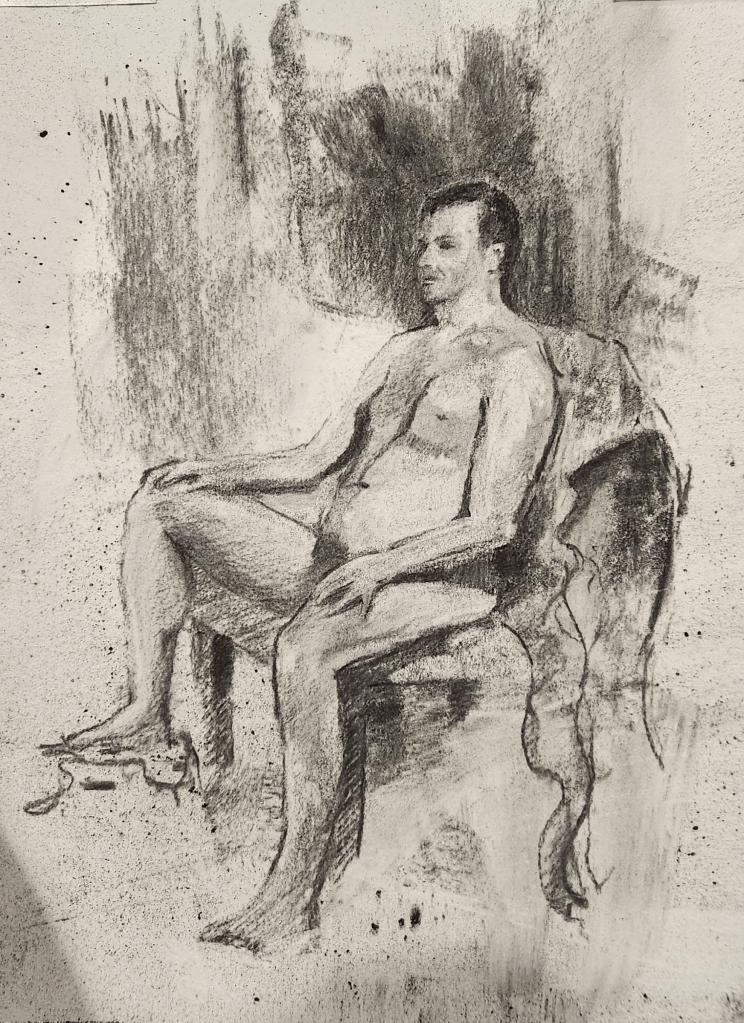
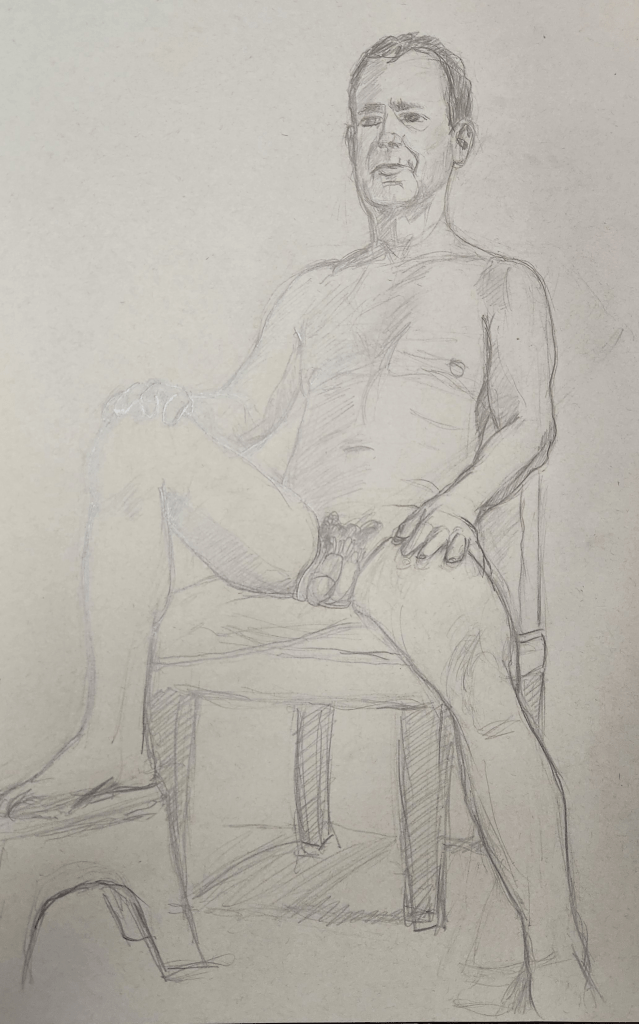
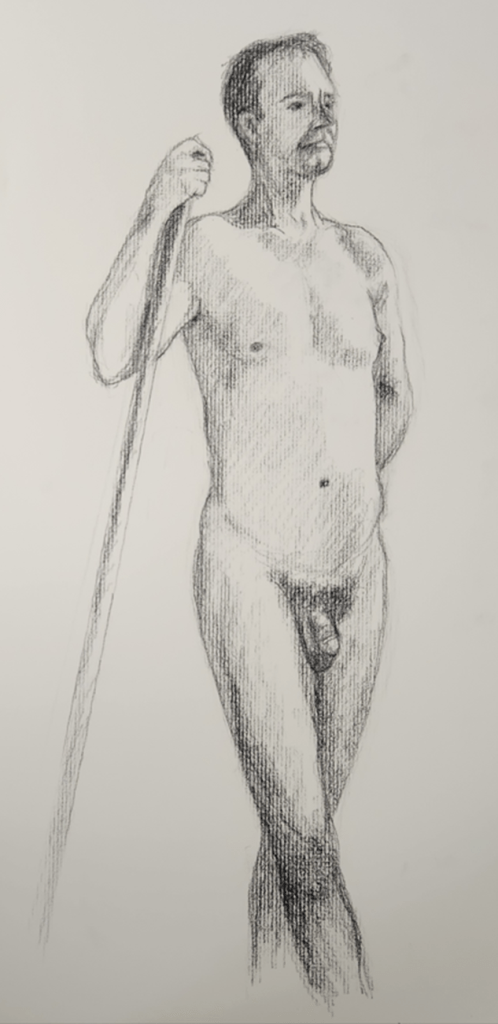
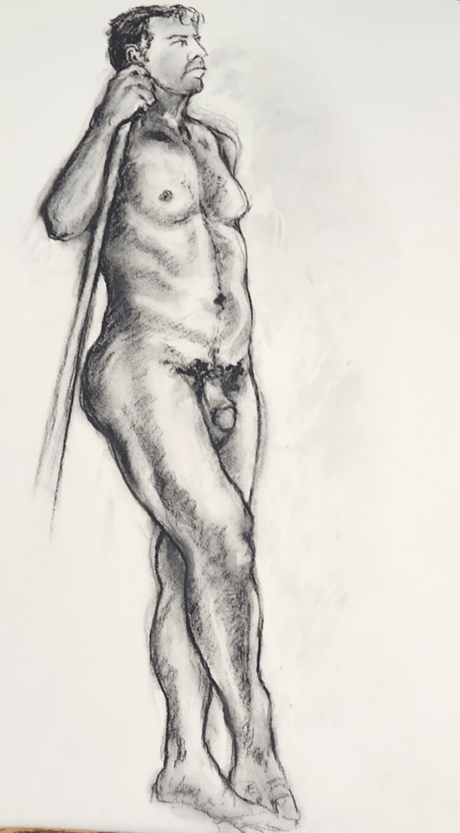

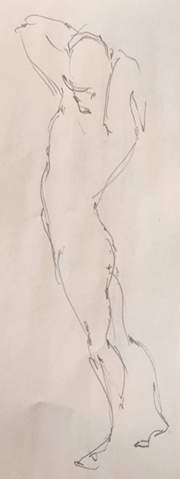
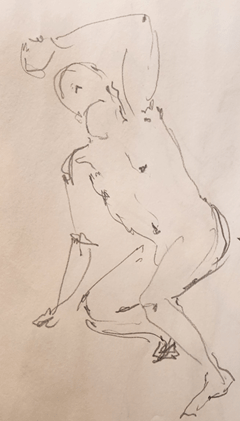
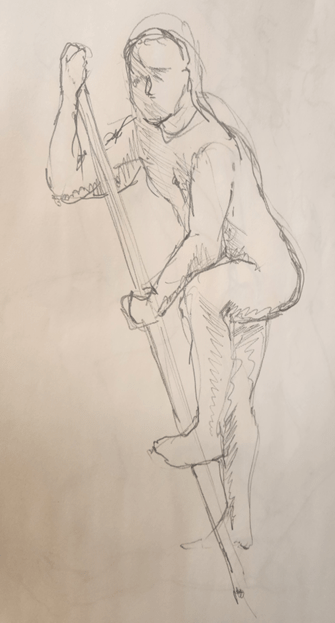
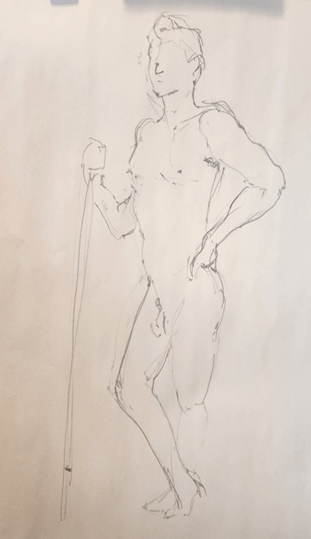


 Figure Model Musings
Leave a comment